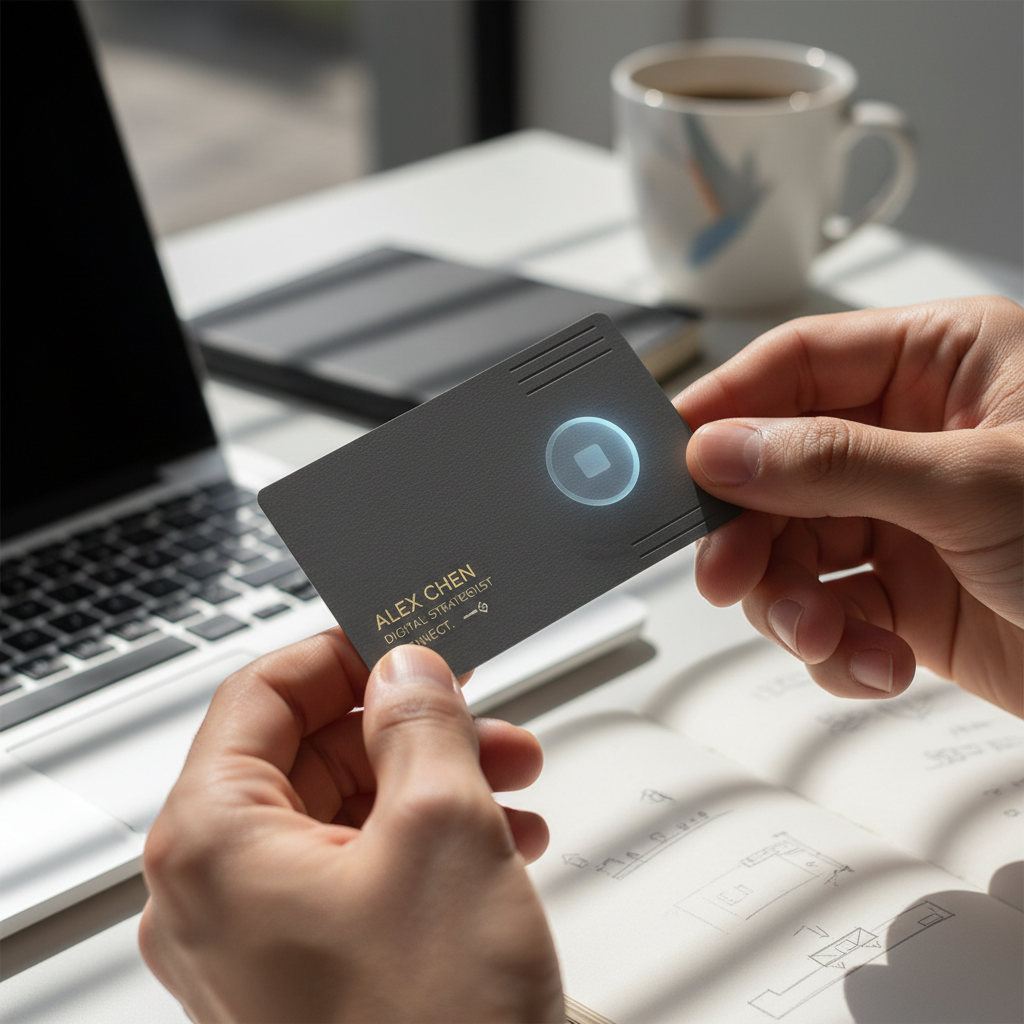
NFC business cards win for modern professionals by offering instant contact sharing and superior data storage that paper alternatives cannot match. When evaluating NFC business cards vs traditional options, the digital choice provides better long-term value through its durability and ability to update contact details instantly without the need for reprinting.
Imagine attending a high-stakes networking event at the DIFC or a trade show at the Dubai World Trade Centre. You exchange paper cards with twenty potential leads, only to realize later that your physical handouts likely ended up in a forgotten stack or, worse, a trash bin. This friction between a physical introduction and a digital follow up is where most professional relationships wither. As the regional corporate landscape shifts toward total integration, the tools you use to represent your personal brand must keep pace. Selecting between traditional cardstock and Near Field Communication technology is no longer just about aesthetics; it is about operational efficiency and data retention. In this guide, we evaluate the strategic advantages of NFC business cards. You will discover the long term cost analysis, the specific benefits for Dubai freelancers, and how to integrate these high tech tools into your daily workflow.
The Evolution of Networking in the Digital Age

Networking in Dubai is a high-speed discipline. At massive events like GITEX Global or the Arabian Travel Market, professionals navigate a landscape where a single afternoon can yield dozens of high-value connections. In this environment, the traditional ritual of exchanging paper cards remains a respected cultural staple. However, the sheer volume of interaction often creates a bottleneck. When a consultant or freelancer returns from a trade show with a stack of two hundred physical cards, the administrative burden of manual data entry leads to friction and lost opportunities.
The debate regarding NFC business cards vs traditional paper options is no longer just about aesthetics; it is about data integrity. Dubai’s business ecosystem is rapidly shifting toward AI-driven solutions and automation to capture and process leads in real time. While the tactile experience of a premium paper card has its charm, modern professionals are prioritizing efficiency. They require contact information that flows directly into a CRM rather than sitting in a desk drawer.
This digital shift is driven by a necessity to reduce administrative work so that members of the Smart Aguila network can focus on high-impact strategy rather than transcribing phone numbers. As the city cements its status as a global tech capital, the tools used to connect must evolve to match the pace of the market. Transitioning to smarter hardware is the first step in building a more resilient, tech-forward professional identity.
What is an NFC Business Card and How Does it Differ from Digital Cards?
Understanding the terminology is critical because "NFC" and "digital" are frequently used interchangeably, yet they serve distinct functions in a professional toolkit. An NFC (Near Field Communication) business card is the hardware. It is a physical card, often crafted from durable materials like matte PVC, sustainable wood, or metal, that houses a tiny, unpowered microchip. Conversely, a digital business card is the software or landing page that stores your contact information, portfolio, and social links. The card acts as the key, while the digital profile is the destination.
The "tap to share" mechanic functions via short-range wireless technology. When the card is held within a few centimeters of a modern smartphone, the chip transmits a signal that prompts the phone to open your digital profile instantly. There is no requirement for a dedicated app or manual scanning. This seamless interaction stands in stark contrast to the manual labor required by paper. With traditional cards, the recipient must manually type names, emails, and phone numbers into their device, a process prone to human error and often postponed until the card is eventually lost or discarded.
By utilizing this technology, professionals within the Smart Aguila network can significantly reduce administrative work for both themselves and their new connections. Instead of handing over a static piece of cardstock, you are providing a dynamic portal. This integration is a cornerstone of the AI-driven solutions and automation that modern businesses use to ensure no lead is forgotten. In the high-velocity markets of Dubai, moving from a physical object to a digital action ensures that your first impression remains functional and accessible long after the initial meeting ends.
NFC Business Cards vs Traditional: A Feature Comparison
To choose the right tool for high-stakes networking in Dubai, a direct comparison of NFC business cards vs traditional paper options reveals significant differences in operational efficiency. While paper cards serve as a physical memento, they are functionally static. In contrast, an NFC card acts as a dynamic interface that bridges the gap between a physical handshake and a digital database.
Feature | Traditional Paper Cards | NFC Business Cards |
|---|---|---|
Data Capacity | Limited to name, title, and basic contact info. | Unlimited links to portfolios, social media, and CRM forms. |
Editability | Requires a full reprint for any data change. | Instant updates via a central cloud dashboard. |
Longevity | Finite; requires constant restocking of boxes. | High; one durable card lasts for years. |
User Action | Requires manual typing into a phone. | Contactless tap to transfer data instantly. |
Data capacity is the most immediate differentiator. A standard paper card offers roughly 50 square centimeters of space, forcing professionals to omit critical details like project case studies or specific service menus. An NFC card removes these physical boundaries, allowing the Smart Aguila network to direct leads straight to interactive content or AI-driven solutions and automation. This depth of information transforms a simple contact exchange into an immersive brand experience.
Editability also directly impacts how modern professionals reduce administrative work. If a consultant changes their office location or updates a WhatsApp number, traditional cards become instant waste. Research indicates that 88 percent of paper cards are discarded within 24 hours, often because the information is either incomplete or requires too much effort to digitize. With NFC technology, updates are handled through a web interface. This ensures your network always has access to your current credentials without the environmental or financial cost of a reprint, turning a single card into a permanent asset.
The Real Benefits of NFC for Small Businesses and Freelancers
For a solo consultant or a small team in Dubai, every minute spent on manual data entry is a minute stolen from strategic growth. When evaluating NFC business cards vs traditional paper versions, the primary advantage lies in the ability to reduce administrative work through direct digital integration. A traditional card is a static end-point that requires manual follow-up; an NFC card functions as a starting trigger for a sophisticated lead-generation sequence.
By tapping your card against a prospect’s phone, you can initiate AI-driven solutions and automation that go far beyond sharing a phone number. For example, the tap can trigger a custom workflow that adds the new contact to a specific CRM tag and automatically sends a personalized follow-up email before you have even left the conversation. This immediate engagement is vital in a competitive market like Dubai, where research indicates 88 percent of paper cards are discarded within 24 hours. Automation ensures that your connection is captured and nurtured before the physical card would have even reached a desk drawer.
Members of the Smart Aguila network use these tools to maintain a professional edge without the need for a dedicated administrative team. Instead of spending hours after an event at the Dubai World Trade Centre transcribing handwritten notes, a freelancer can rely on their NFC profile to handle the intake process. This shifts the focus from simple contact sharing to building an automated pipeline, ensuring that every handshake has a measurable path toward a signed contract.
Are NFC Business Cards Worth It? The Cost Analysis
Evaluating the financial impact of NFC business cards vs traditional paper alternatives requires looking beyond the initial purchase price. In the Dubai market, a high-quality box of 250 to 500 paper cards typically costs between 150 and 300 AED. For an active networker, this is a recurring quarterly or bi-annual expense. Conversely, a premium NFC card represents a one-time investment of 100 to 250 AED.
Metric | Traditional Paper Cards | NFC Business Card |
|---|---|---|
Initial Cost | 150 - 300 AED per box | 100 - 250 AED (one-time) |
Recurring Cost | Frequent reprints for data updates | Zero for digital updates |
Lifespan | Finite; runs out quickly | Years; durable hardware |
Waste Factor | 88% discarded within 24 hours | Near zero; remains with owner |
Beyond direct costs, the environmental and efficiency toll of paper is significant. Research indicates that 88 percent of paper cards are thrown away within 24 hours of being received. This waste represents not just lost capital, but lost data. By switching to a single, durable card, members of the Smart Aguila network can reduce administrative work associated with managing physical stock and reordering. Moving toward AI-driven solutions and automation starts with choosing tools that eliminate physical clutter and recurring overhead, allowing your budget to focus on growth rather than stationary.
Potential Disadvantages of NFC Technology
Despite the favorable cost-benefit ratio, technical limitations occasionally surface. A realistic assessment of NFC business cards vs traditional paper requires acknowledging that technology is not always universal. The primary disadvantage involves smartphone compatibility. While nearly all modern devices are NFC-equipped, older models, typically those manufactured before 2018, may lack the hardware or require the user to manually enable NFC in their settings. This can create a moment of friction during fast-paced networking at events like GITEX.
Disadvantage | Practical Impact | Mitigation Strategy |
|---|---|---|
Hardware Compatibility | Pre-2018 phones may not read NFC chips. | Use a fallback QR code on the card. |
User Learning Curve | Confusion over "tap" locations on different phones. | Briefly guide the recipient during the exchange. |
Single Point of Failure | Losing one card halts physical networking. | Keep a digital version in your mobile wallet. |
There is also a minor learning curve. Some users remain unfamiliar with the "tap to share" gesture, leading to awkward interactions if the connection is not immediate. Furthermore, unlike a box of 500 paper cards, losing your single NFC card means losing your primary networking tool until a replacement arrives. To ensure members of the Smart Aguila network remain reachable, a hybrid approach is best. Utilizing a card with a printed QR code acts as a fail-safe, ensuring you can still reduce administrative work and deploy AI-driven solutions and automation even when meeting someone with a legacy device.
How to Integrate Your Business Card with Your Workflow

Maximizing the potential of modern networking requires viewing the NFC card as a digital gateway rather than a static placeholder. While the comparison of NFC business cards vs traditional paper often centers on the physical exchange, the true value lies in the subsequent data journey. Experts within the Smart Aguila network leverage these cards as triggers for complex, time-saving sequences that begin the moment a smartphone detects the chip.
A sophisticated workflow might look like this: 1. A prospect taps your card at a Dubai trade show. 2. Their contact details and the meeting location are instantly sent to a dedicated CRM or a project planning document like Notion or Airtable. 3. An automated tag is applied, triggering a personalized follow-up email via your mailing list provider. 4. A task is created in your calendar to review their LinkedIn profile 48 hours later.
This level of integration allows professionals to reduce administrative work significantly; transforming a brief encounter into a structured lead-generation process. By utilizing AI-driven solutions and automation, you ensure that no connection is left to wither in a stack of paper. This turns a simple networking tool into a robust engine for business growth, ensuring your focus remains on high-level strategy rather than manual data entry.
Choosing between NFC and traditional cards ultimately depends on how you want to be remembered in the Dubai market. While paper cards offer a tactile tradition, NFC technology provides the digital edge needed for modern networking. If you want expert help to refine your branding and networking strategy, you can learn more about our specialized services and team. We are here to ensure your professional tools reflect the high standards of your business; helping you connect more effectively with every new contact.